
Message from the Desert
Living in a time between rivers.

Dear Reader,
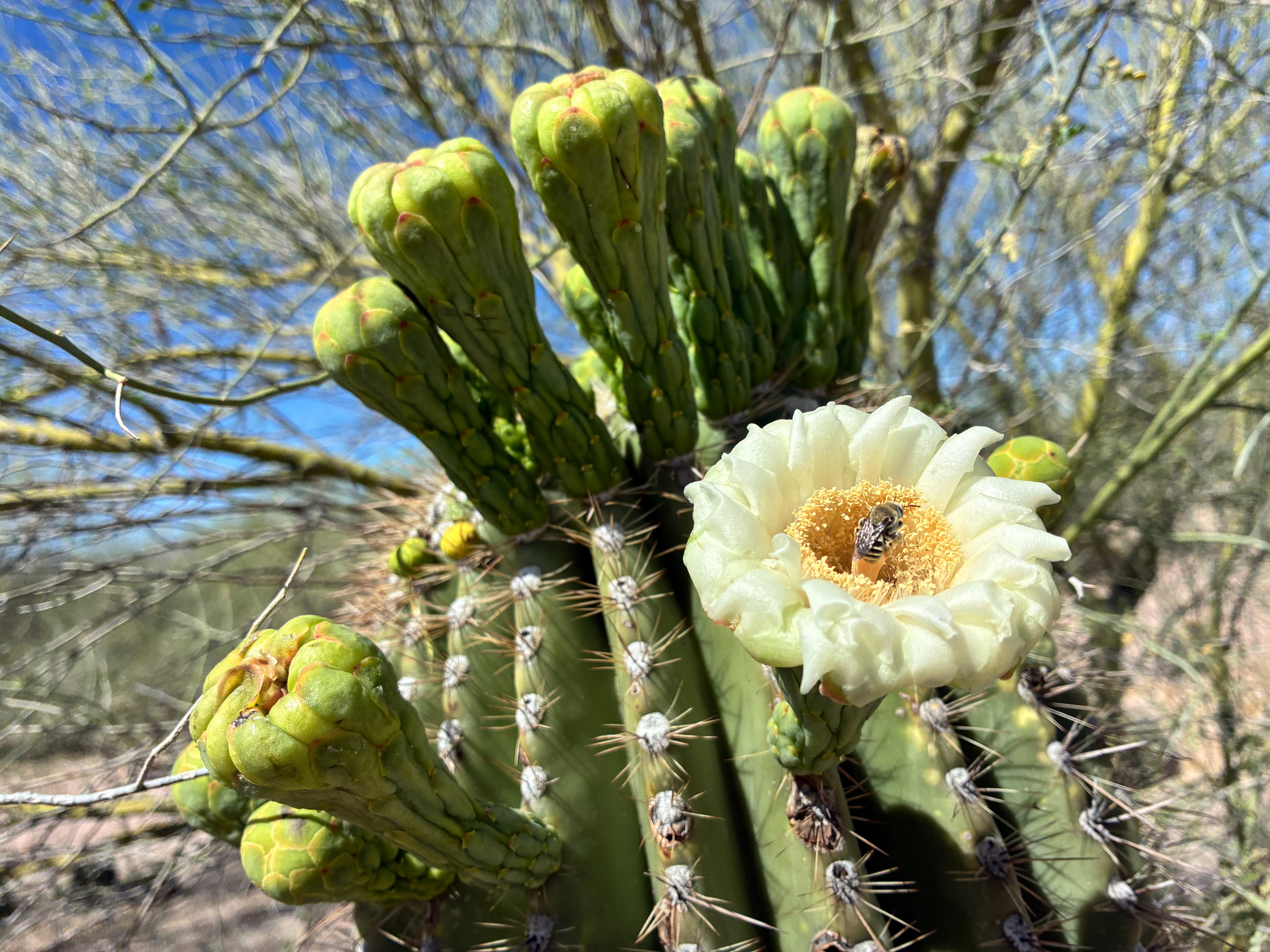
After half a century of living in Utah near the shore of Great Salt Lake, I migrated to the Sonoran desert last fall to live near my daughter. I’m in awe of this place with its night blooming saguaros and ubiquitous hummingbirds, but I still ache for the company of the lake and lake-facing friends.
Here in Tucson, I frequently pass by a capacious but empty river bed. People here call it the Santa Cruz River but I have yet to see it run. Still, some folks I’ve met refer to this empty bed as “the mighty” Santa Cruz. They do so with sincerity. Once shaded by Cottonwood trees and lined by a vast Mesquite bosque, perennial flow once supported an entire symphony of songbirds, mind-boggling to ornithologists. The human inhabitants here, the Tohono O’odham People and the Hohokam before them, practiced agriculture harmoniously without harming the river which they knew to be sacred.
What happened next is painfully familiar: colonizers arrived and diverted the water. Their reckless extraction of the water table lowered it beyond the deep reach of Cottonwood roots. They cut down the last of the Mesquite trees.
The forest was annihilated and the river died with it.
Water was still flowing in the seventies when I was a small child. I wish that I had lived here then so that I could have swam in it in, but I didn’t. The other day, I ambled through the dry bed and sang to the water instead. I sang to the water that was and to the water that will be again. I sang to acknowledge and encourage. My song was a prayer.
There is movement here in Pima County to restore the Santa Cruz river by 2070. It’s led by the Watershed Management Group who has clearly articulated values alongside a vision with precise timelines. One of my favorite values is “We are One Watershed” which proclaims diversity, equity, and inclusion and another is “River as Teacher” signifying reverence and humility in relationship to water. Five years in to a fifty year plan, folks here are making serious progress and hitting their marks. I will be dead or 104 when this river is replenished. I feel inspired to spend the rest of my life working for the restoration of waters.
I am curious about how the water-wisdom held by current and past cultures of this desert might also help those of us working to restore Great Salt Lake. I notice the length of the time line here, that the plan is determined but unhurried. It moves steadily at the speed of life, the speed of trust.
A few years back in the Great Salt Lake crisis, Utah’s governor invited people to pray for precipitation. Like many folks I was irked. While I don’t believe in an interventionist god, I do practice prayer. What bugged me was the governor’s failure to recognize that legions of people were already praying on behalf of the lake full time. We had been keeping vigil and lobbying for years already, counting our footsteps as we walked to the receding water, gathering perhaps the longest love letter ever written to a lake word by word, line by line: each verse a prayer of gratitude to the life that sustains us and a plea for her continuance. We prayed and still pray perpetually.
Last fall, the governor announced that the state of Utah would save the lake in time for the 2034 Olympics. “We will not let the lake fail. Period.” he proclaimed. I wish he would have said “we will not fail the lake.” There is a difference between coercion and commitment. He said this at a press conference on the shore which later somehow became an abrupt ending to an otherwise worthwhile Sundance film. (Watching that part felt like viewing an unannounced campaign commercial.) Let me acknowledge that his stated goal is desirable, even possible. To succeed we would need a surge of generosity from wealthy stake-holders; success would also require bold and coherent leadership from elected officials. The timeline is ambitious.
Recently, the governor met with our deranged president who subsequently promised one billion federal dollars to “Make Great Salt Lake Great Again.” This resulted in a tense moment for our movement. Perhaps this inflection point is also a test of our faith. Lake-coalition leaders are now grappling with hard questions: Do we take these dollars to address our all-too-real eco-emergency? If we do, what will become of the intersectional social justice values we have agreed on and proclaimed for the past fiver years? Just who would we be saving the lake for in this story? Who will be left behind? What would this money actually cost us?
Subsequent to the promise of funds, some MAGA imagery and rhetoric emerged within in this movement. It happened fast and without warning, the suddenness amplifying the harm. The words and images landed in my body as imminent threats. They have not yet been revoked and this causes me to lose sleep. I imagine I would feel as just as strongly if the impending threat of fascism wasn’t personal but I don’t know for certain because it is. My only child is transgender and my beloved is an immigrant. Is the lake movement a safe place for us to be? I am searching for new ways to be brave. Even now I am writing to try to revive my battered courage and to stay lovingly engaged. There is now a significant rift in what has been for the past five years a robust coalition. There is also an on-going discussion. I am doing my best to stay in it, praying for repair. In this case, my prayer is my presence. Against the odds I still believe in prayer.
Shortly after this promise of federal funds for the lake came the announcement of an impending ICE mega-facility on the lake’s shore. A 7,500-10,00 person warehouse purchased for this cruel purpose, welcomed by the very same governor who asked for lake money. The sequence of these events feels beyond coincidence. (Necessarily, we measure the size of warehouses in people now.)
Everything we do matters and how we do it matters even more. Any means we employ to “save the lake” must be ethically aligned with both spiritual and physical restoration. We must center justice. Great Salt Lake is a sentient and responsive entity. Woe to those who underestimate her integrity. She is a god we have desecrated and blasphemed who is now leaving us reluctantly. Her thriving life is incompatible with the presence of a concentration camp on the lakeshore. She will not abide it. This is something I know in my marrow.
State leaders have expressed worry about being embarrassed if the world comes for the Olympic games and finds us without snow. If only they would be just as ashamed to be found on the wrong side of history and even more so on the wrong side of the explicit spiritual requirements to welcome the stranger, visit the imprisoned, and feed the poor. We will not save the lake if we cannot safeguard our own souls. If we betray our neighbors, we also fail the ecosystem and ourselves.
We will not save anyone or anything without adhering fiercely to our values. Diversity is life and ecology is queer. Inclusion means all people, human as well as lives beyond human. We must acknowledge and condemn the ongoing abhorrent violence against bodies. Those who have been last, including the lake, must become first.
This is a call beyond prayer. To repair what is rent, to mend what is disassembled, we must actually repent. No policy or law can fix what culture fails to uphold. The imperative culture changes will require slow devoted work without shortcuts. This will take time. Meanwhile our sacred lake retreats. Hosting the Olympics will be the least of our problems unless we rapidly and radically transform our ways. We must focus now on mutual aid and providing community resources.
I am living here in the desert in a time between rivers, a river that was and river that will be again. Soon we may live in a time between lakes.
Even in this era of devastating losses, life is likely to surprise us. Water will return. Brine shrimp cysts will awaken. Rivers will become mighty again. We could still learn how to behave beautifully in relation to life and each other. We are now deciding the future of our own species in relation to a much larger story. As we do, we dance on a precipice.
We must collectively grow our courage to thoroughly resist fascism. We cannot afford to waver. It is a grave mistake to think that any form of compliance with the murderous could actually serve the lake.
I pledge my allegiance to the justice that will roll down like waters. I will make my life a prayer for a vital future beyond my own time.
love,
nan
I think you hit the nail on the head, Nan. Cox seems to think that trump's money (if it ever materializes) will pay for some kind of magic geoengineering solution without respect for the Great Salt Lake ecosystem. With a billion dollars, surely there will be no need to implement water conservation, stop proposed Bear River developments, buy out agricultural water rights, conserve wetlands or do anything else inconvenient. Cox can just throw money at the problem and claim that because he is spending a lot he is doing something to help. I doubt that trump will ever really give Utah the money, but if he does, it's essential for Great Salt Lake activists to insist that it be spent on ecological stewardship, not pie-in-the-sky Republican proposals to keep on sucking Utah dry. You are right that there is a difference between coercion and commitment. Before the Kennicott Copper museum fell into the pit, it had a display that said, "Copper is a gift from nature". Clearly, with all that open-pit mining and blasting away mountains nobody was showing any gratitude for the "gift". The lack of gratitude is a problem.
reality and inspiration have you sent this to rev j sylvan and the tribune